AI Hospital Management Software with Voice-to-Prescription
· HextGen Team
AI Hospital Management Software with Voice-to-Prescription
By HextGen Team · July 8, 2026
Watch any busy OPD in India for one hour. The doctor talks to the patient for two minutes. Then looks down and types, or writes, for three. Multiply that by 60 patients a day. Half the doctor's day goes into documentation, not treatment.
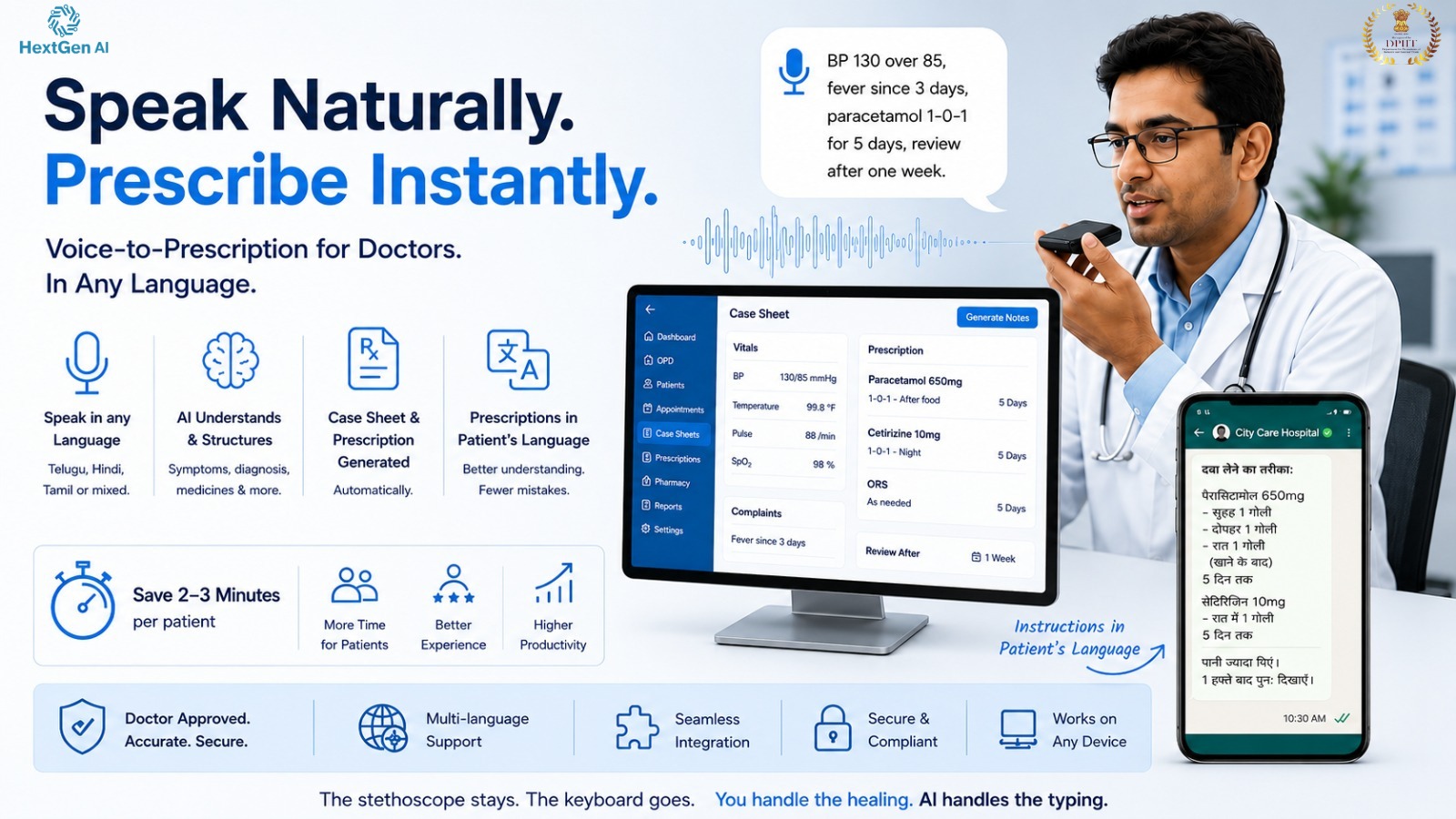
Now imagine the doctor simply speaks — "BP 130 over 85, fever since three days, paracetamol one-zero-one for five days, review after one week" — and the case sheet fills itself. Vitals in the vitals box. Medicines in the prescription table. Next appointment booked. That is voice-to-prescription, and it is already working inside AI hospital management software used by Indian clinics today.
What is voice-to-prescription?
Voice-to-prescription means the doctor dictates the consultation, and the software converts speech into a structured case sheet and prescription automatically. It is not a simple recording — the AI understands what is a symptom, what is a diagnosis, what is a medicine, and puts each in the right place.
Old dictation software just typed what you said, mistakes and all. Today's AI listens like a trained medical scribe. Say "Dolo 650 twice daily after food" and it creates a proper prescription line — medicine name, dose, frequency, instructions. The doctor reviews, makes corrections if needed, and signs. Thirty seconds instead of three minutes.
Can doctors speak in their own language?
Yes — and this is the part that matters most in India. Good AI hospital management software today accepts speech in Telugu, Hindi, Tamil, or mixed language — the way doctors actually talk — and still produces a clean English case sheet.
Real consultations in India are never in one language. A doctor might describe the complaint in Telugu, say the medicine name in English, and give instructions in a mix of both. Modern speech AI is trained for exactly this. The doctor speaks naturally; the system translates and structures everything into standard medical English documentation. No behaviour change needed. No "please speak slowly in English only."
This single feature decides whether doctors actually use the system or abandon it in a week. Technology should adjust to the doctor — not the other way round.
Can patients get prescriptions in their own language?
Yes. The same AI can translate dosage instructions into the language the patient reads comfortably — Telugu, Hindi, Tamil, or English. The doctor documents once, and the patient receives instructions they actually understand.
Think about what happens today. The prescription says "1-0-1 after food." The patient nods at the counter, goes home, and calls the clinic the next day: "Morning and night, or afternoon also?" Or worse — they don't call, and take the medicine wrong. A large share of medication mistakes happen for one simple reason: patients not understanding the instructions.
Now imagine the same prescription delivered on WhatsApp with the dosage written in the patient's own language — one in the morning, one at night, after food — in words they read every day. No confusion. No guessing. The elderly patient's family doesn't need to decode English medical shorthand.
This matters most in small towns and semi-urban India, where English is a barrier for many patients. The medicine names stay standard for the pharmacy, while the instructions speak the patient's language. Both sides of the counter understand the same prescription.
Does voice documentation actually save time?
Yes. Doctors using voice documentation typically save 2–3 minutes per patient. In a 60-patient OPD, that is up to two hours a day returned to the doctor.
Think about what those minutes contain today: typing patient history, selecting medicines from long dropdowns, entering vitals field by field. Speaking is simply faster than typing — most people speak 3–4 times faster than they type. And because the AI fills structured fields, there is no formatting work afterward.
Two hours a day means more patients seen, or the same patients seen with more attention, or the doctor going home on time. All three are wins.
How does this improve the patient's experience?
Patients get more eye contact, clearer prescriptions, and complete medical records. The consultation feels like a conversation, not an interview conducted over a keyboard.
Ask patients what they dislike about hospital visits, and "the doctor kept looking at the computer" comes up more than you would expect. When documentation happens by voice, the doctor faces the patient. Trust improves. Patients explain their problems better.
There is a quieter benefit too: completeness. Handwritten case sheets in a hurry skip details. Voice documentation captures the full picture — history, complaints, advice — so the next visit, or the next doctor, has everything. And a prescription generated from structured data is always readable. No pharmacy guessing games with handwriting.
Is voice-to-prescription accurate enough for medical use?
Modern medical speech AI reaches high accuracy, and the doctor always reviews before saving — so the final prescription is doctor-approved, every time. The AI drafts; the doctor decides.
Accuracy has two layers here. First, speech recognition tuned for medical vocabulary and Indian accents. Second, smart matching — when the doctor says a medicine name, the system matches it against the hospital's own pharmacy stock list, so the prescription shows the exact brand the pharmacy carries, not a random spelling. Wrong matches are flagged for the doctor to correct in one tap.
No serious AI hospital management software removes the doctor from the loop. It removes the typing, not the judgment.
What should hospitals check before choosing voice documentation?
Check four things: language support for your region, integration with your existing case sheets and pharmacy, review-before-save control for doctors, and whether it works on ordinary devices without special microphones.
A quick checklist:
Does it understand your doctors' natural mix of languages?
Can it give patients their instructions in the language they read?
Does the output land directly in your case sheet, prescription, and pharmacy modules — or is it a separate app creating copy-paste work?
Can the doctor edit everything before saving?
Does it run on the tablets and computers you already own?
Is patient audio handled securely?
If voice is a separate tool that does not talk to your hospital software, you have added one more system, not removed work. Voice documentation belongs inside the AI hospital management software, not beside it.
FAQ
The stethoscope stays. The keyboard goes.
Doctors did not study medicine for ten years to spend half their career typing. Voice-to-prescription gives that time back to patients — in the doctor's own language, with instructions in the patient's own language. Modern AI hospital management software like HextGen already includes voice-to-casesheet built in, working the way Indian doctors actually speak.